R1CORD vs. Rabbit OS3 Isn’t the Real Story
Chipp Walters 9/24/26
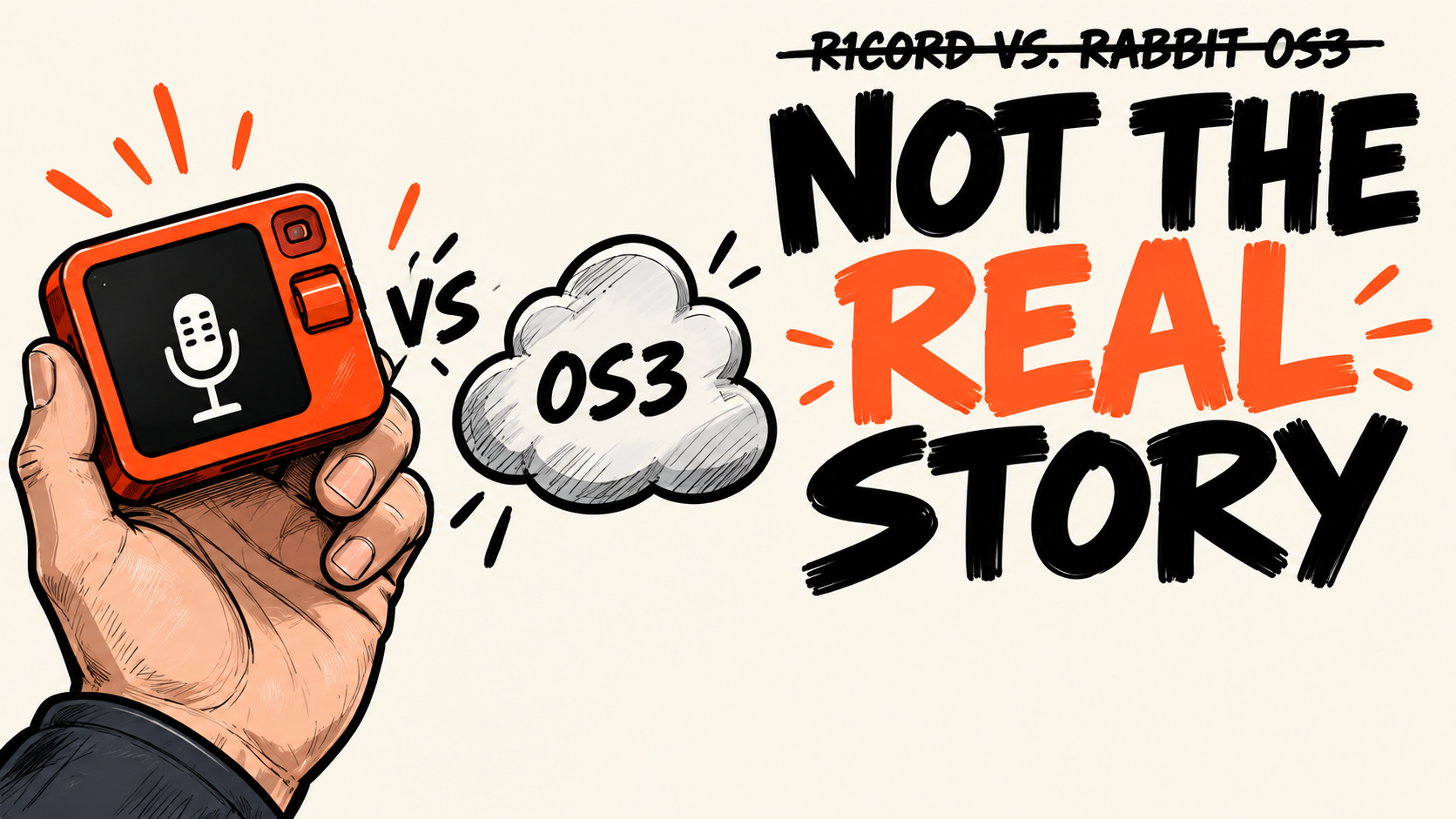
A friend of mine who follows me on Patreon asked me about a product I’m working on called R1CORD. I had a $200 Rabbit R1 sitting in a drawer doing nothing, so I decided to turn it into something I would actually use.
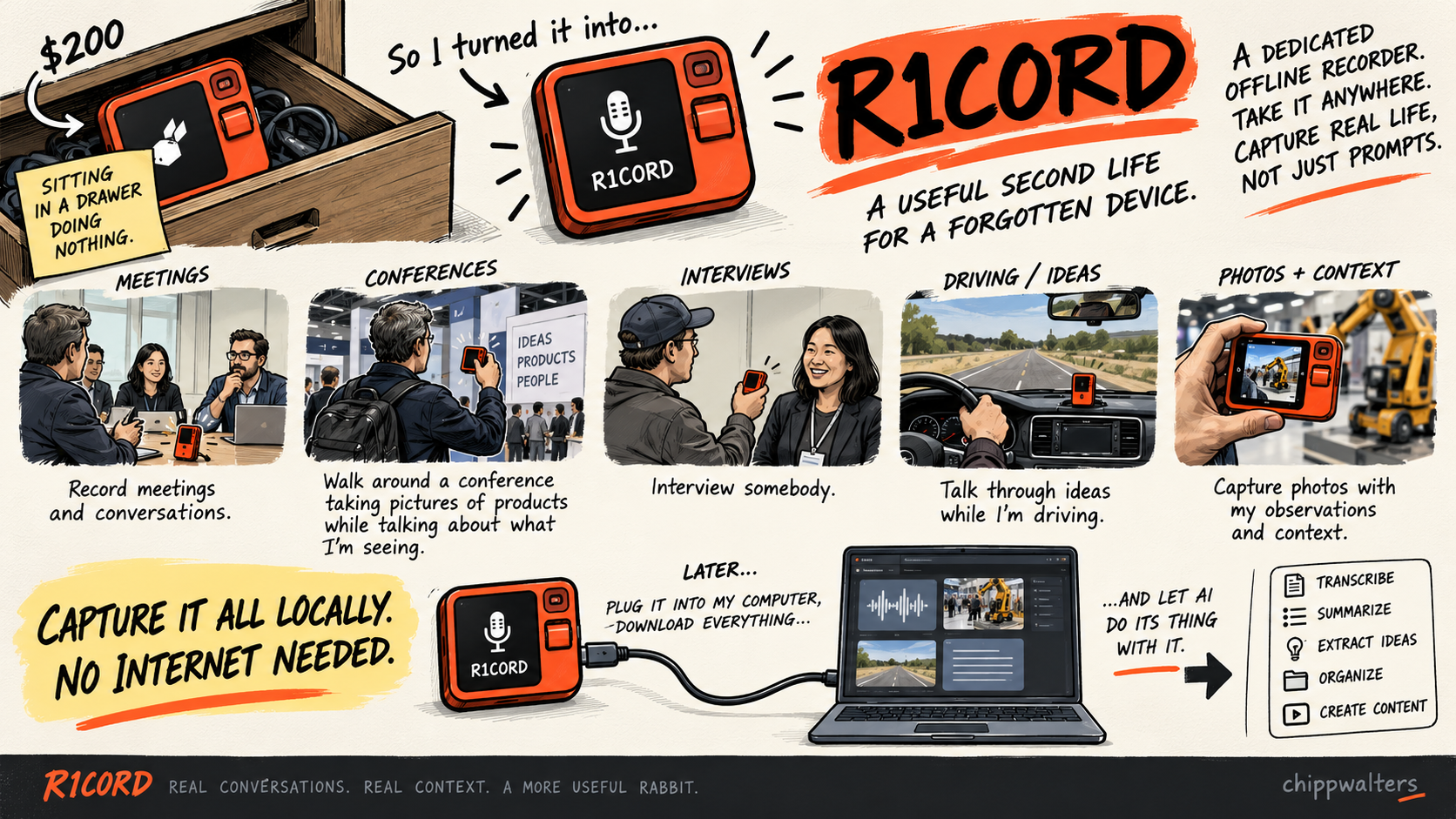
The idea is simple. Turn the Rabbit into a dedicated offline recorder. I can take it anywhere. I can record a meeting, walk around a conference taking pictures of products while talking about what I’m seeing, interview somebody, or just talk through ideas while I’m driving. It captures all of that locally. I don’t need an internet connection. Then I can plug it into my computer later, download everything, and let AI do its thing with it.
He sent me a link to Rabbit’s new OS3 and basically asked, “Have you seen this? Doesn’t this change what you’re doing with R1CORD?”
I had seen it. And the more I thought about it, the more I realized that question gets at exactly why I stopped using the Rabbit in the first place.
The Rabbit Problem
Problem One: Always Online
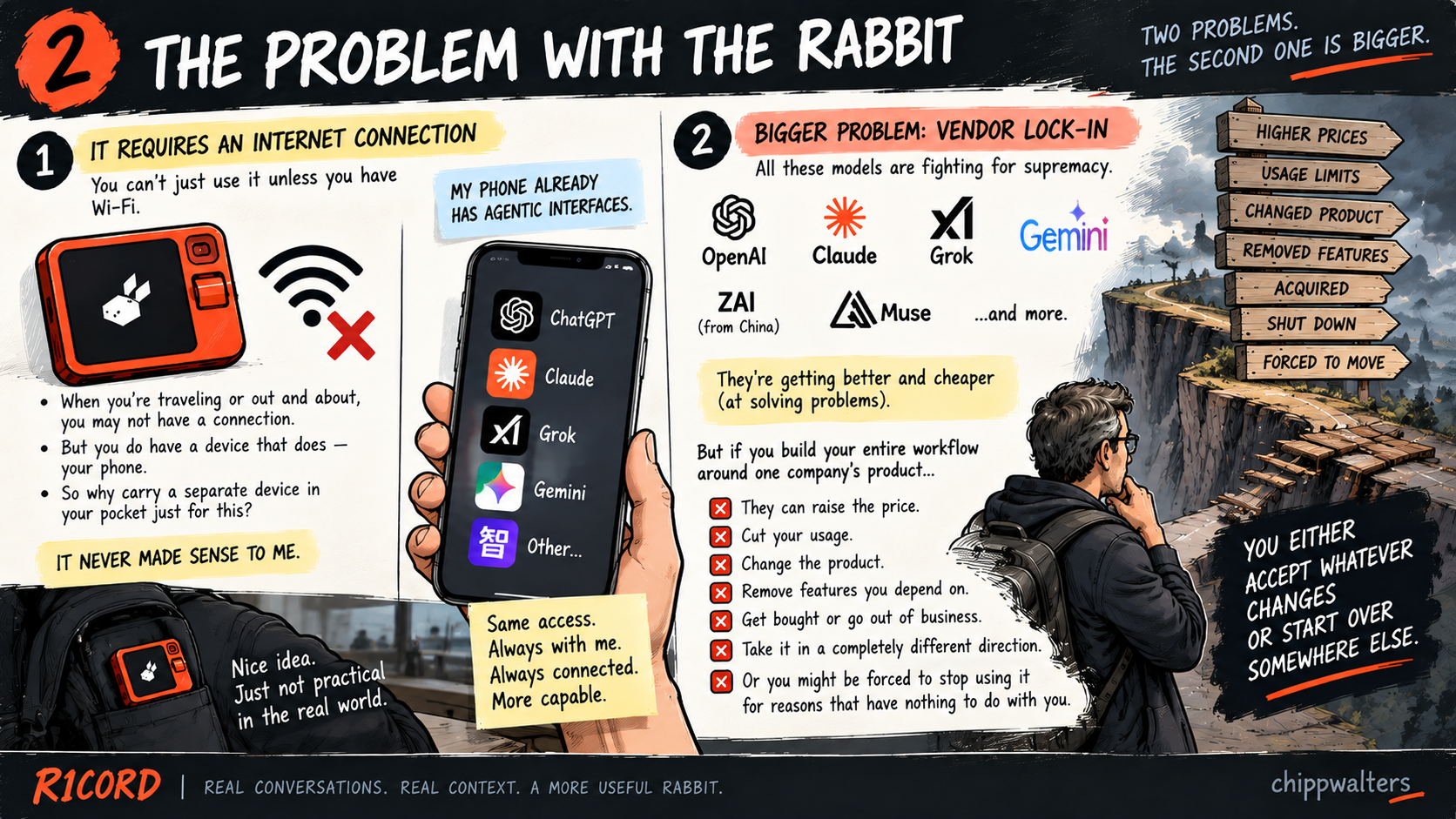
Let me start with the problem I’ve had with the Rabbit from day one. It has to be connected to the internet to work. You can’t just use it unless you have a Wi-Fi connection. When you’re out and about, traveling, moving around, you may not have that connection. But you do have a device that does, and that’s your phone. So why not just use an agentic interface that already exists on your phone? It never made sense to me why you need a separate device in your pocket just for this.
That’s problem number one.
Problem Two: Vendor Dependency
Problem number two is bigger.
All these models are fighting for supremacy. Claude, OpenAI, ZAI (from China), Grok, Muse, Gemini. They’re getting better and cheaper, not from a monthly spend standpoint, but from a pure processing power standpoint. They’re getting cheaper at solving problems.
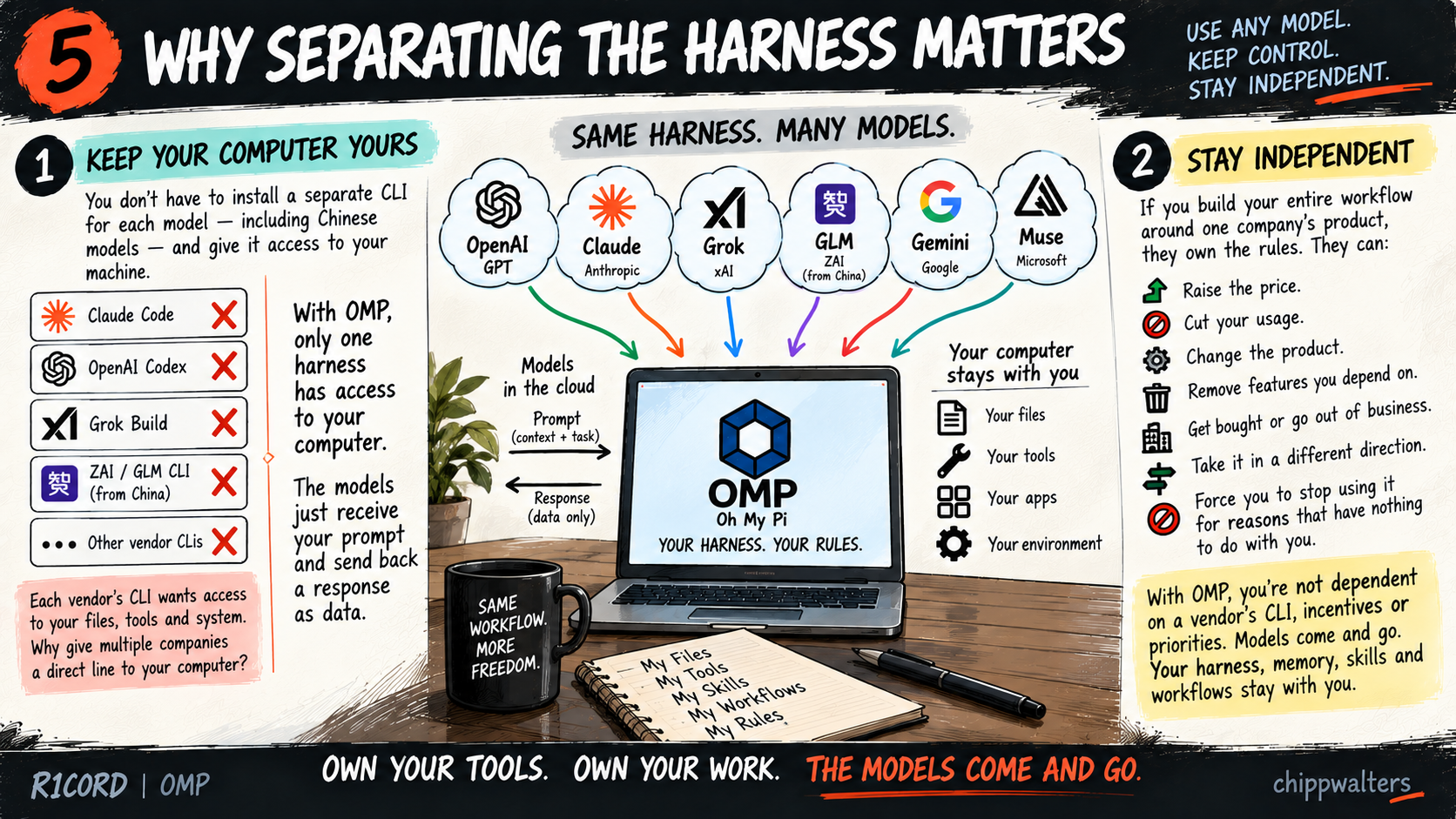
And if you build your entire workflow around one company’s product, they own the rules. They can raise the price, cut your usage, change the product, remove something you depend on, or just decide to take it in a completely different direction. The company could get bought, go out of business, or simply stop making the thing you built your workflow around. You might even be forced to stop using it for reasons that have nothing to do with you. And what are you going to do? You’ve built your business around it. You either accept whatever changed or start over somewhere else.
I’ve also seen these vendor CLIs repeatedly make basic errors that waste round trips and tokens, errors I’ve eventually had to program around myself. Maybe that’s just an engineering problem. But when the company controlling the agent also benefits from increased usage, our incentives aren’t necessarily aligned.
The OMP Alternative
So here’s my solution to that problem. A product called OMP, Oh My Pi.
What the Harness Does
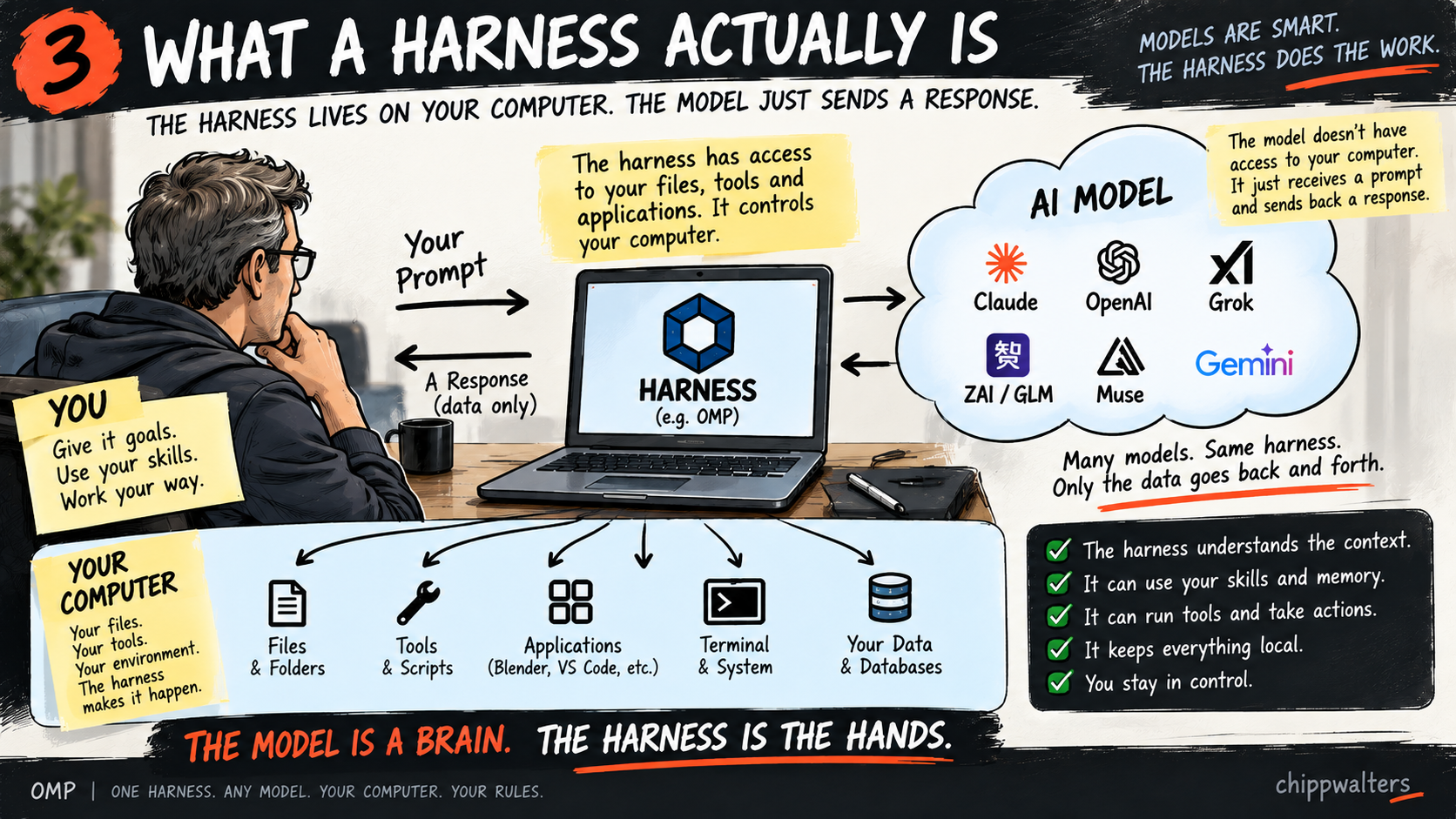
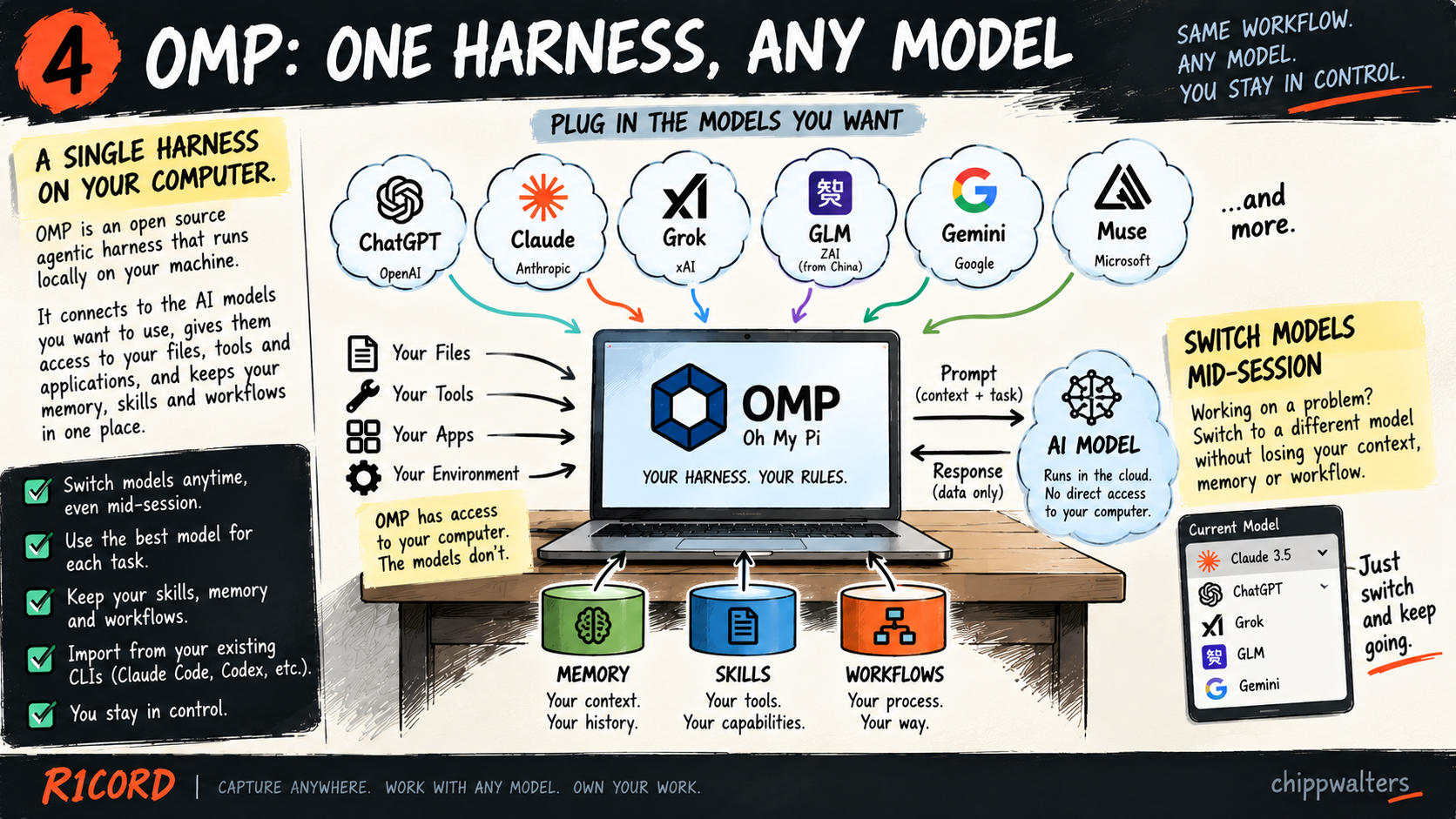
It’s an open source agentic harness. And when I say “harness,” I’m basically talking about the same thing as the CLIs you may already be familiar with. Claude has Claude Code. ChatGPT has Codex. Grok has Grok Build. The harness is the part that actually lives on your computer and has access to your files, tools, and applications.
The AI model itself doesn’t have access to your computer. Whether it’s Opus, GPT, Grok, GLM, or whatever comes next, you basically send the model a prompt and it sends a response back, much like using ChatGPT in a browser. It’s the harness that takes that response, understands it in the context of what you’re doing locally, and actually does something with it on your computer.
That’s why the harness matters so much. Each of the proprietary harnesses does this differently. They don’t share the same skills, they don’t share the same memory, and they don’t necessarily work the same way. You can use tools to try to make them share some of this stuff, but it gets messy fast.
One Harness, Many Models
If you use OMP, you get a single harness where you can switch, and I mean switch mid-session, between different AI models. Claude, Grok, ChatGPT, the ZAI models like GLM, all of them. You can even assign weaker models to do research on the web or sort through files, and those get automatically assigned. You can import all your skills from your existing CLIs.
There are two things going on here.
Keep Control of the Layer
First, you have a single harness responsible for the interaction between the AI model and your computer. This actually solves one of the reasons I originally wouldn’t use some of the Chinese models. I may want to use their models, but I don’t want to install a Chinese CLI and give it access to my computer. With OMP, I don’t have to. OMP has access to my computer. The prompt goes out to the model and the response comes back as data. The model isn’t sitting on my machine reading my files or running commands. OMP is.
There’s another advantage to separating the model from the harness. I’m not dependent on a vendor’s own CLI and whatever incentives or priorities went into building it. I’ve used these tools enough to see them repeatedly make mistakes that burn unnecessary tokens and round trips, including some pretty basic behaviors that really should have been fixed by now. Maybe they’re just bugs. Maybe they’re low on the priority list. I don’t know. But when those mistakes cost me tokens and the company providing the CLI benefits from me using more tokens, it’s fair to ask whether our incentives are completely aligned.
With OMP, there’s no question about whose side the harness is on. Its job is to get the work done as efficiently as possible, regardless of which model happens to be plugged into it.
That’s an important distinction.
Keep Your Work
Second, as all these frontier apps get better and leapfrog each other, and some get more expensive and some go away, you don’t lose everything you’ve built.
Your memory is yours. Your skills are yours. Your workflows are yours.
That’s the stuff you’ve spent months or years building, and it shouldn’t matter whether Claude is the best model this month, ChatGPT is better next month, or some model from China suddenly blows them both away. Because it’s an open source harness, you own that layer.
Back to R1CORD
Now, back to R1CORD.
R1CORD isn’t another agentic device. That’s the whole point.
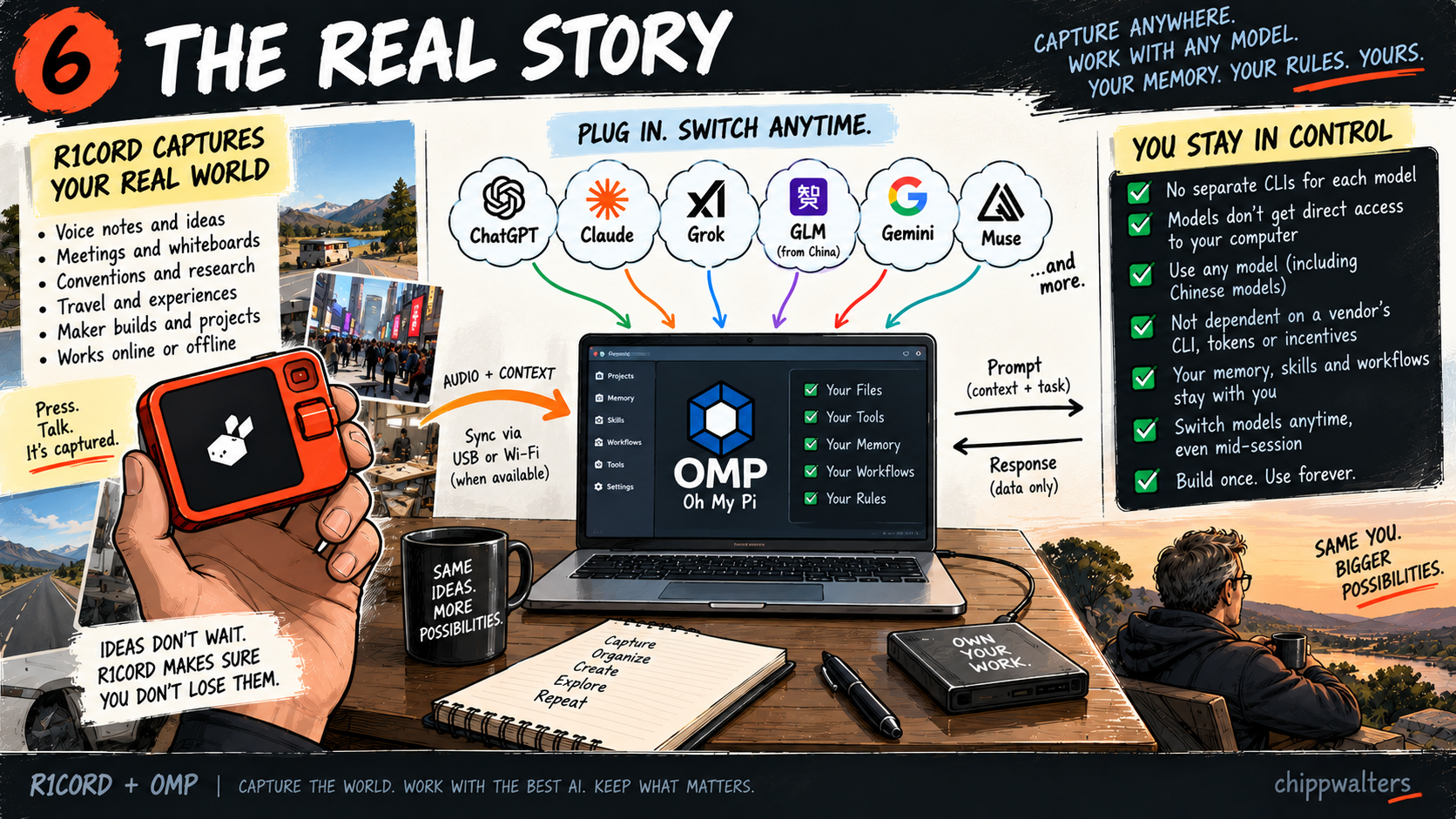
The recording happens offline, on the device, no internet required. The transcription and the generation of different versions happen later, when you have a connection. You’re not dependent on Wi-Fi at the moment of capture.
Why OS3 Doesn’t Change This
Rabbit’s OS3 is interesting. It runs in the cloud, connects to your machines through a local agent, supports bring your own key, and can swap models. But it still routes through Rabbit’s servers. Your content passes through their infrastructure on the way to whatever model you choose. And the memory, the skills, the context, all of that lives in their system.
If Rabbit changes direction, raises prices, changes the rules, shuts down a feature, or gets acquired, you’re along for the ride.
And even if none of that ever happens, I’m still back to my original question.
Why do I need another agentic device in my pocket when I already have a phone?
A Job My Phone Doesn’t Do
That’s why R1CORD makes sense to me. It gives the Rabbit a job my phone doesn’t already do better. It’s a dedicated capture device I can use anywhere, online or offline, without thinking about it.
OMP is the answer to a different problem. It’s where I want the agentic part of my world to live because I control it.
The Real Story
That’s really where I’ve landed after all of this. I don’t want another company owning the layer between me and the AI.
Let Anthropic build great models. Let OpenAI build great models. Let Grok, Google, ZAI, and whoever comes next compete to build the best model they can.
I’ll happily use all of them.
I just want to own everything in between.